Commitments
Materiality – Charting Our Course
Materiality Process
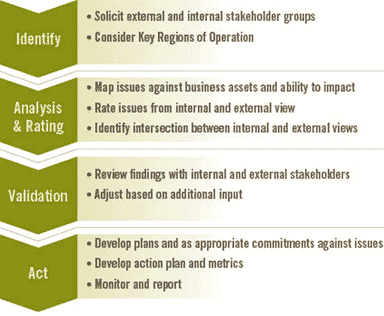
“MATERIALITY ASSESSMENT” IS THE PROCESS OF DEFINING WHAT’S IMPORTANT SOCIALLY, ENVIRONMENTALLY AND BUSINESSWISE TO BOTH OUR INTERNAL AND EXTERNAL STAKEHOLDERS.
An important step in the discovery process for sustainability is to better understand the challenges and opportunities related to our business. We need to listen carefully to the interests of our stakeholders, including our customers, employees, society and shareowners and think about the interests of future generations.
Our people see the materiality process as an exercise involving the analysis of key business issues, risks and opportunities, and how they intersect with stakeholder needs and interests. The gaps and intersections among those issues, risks and opportunities help steer the focus forward. It’s a tool that allows us to focus our intentions and create the solid ground on which we can build our future plans. “Materiality Assessment” is the process of defining what’s important socially, environmentally and businesswise to both internal and external stakeholders. It helps to define what we’re passionate about and where we can make the most positive impact. Materiality helps us focus on the areas that truly matter to the world, stakeholders and the business, enabling the allocation of internal resources towards well-targeted goals and initiatives.
We will not shy away from the tough issues. In this report and in ongoing communications, we plan to address difficult challenges and how we are committed to making a positive impact. In this report, you can read about our approach to challenging issues like innovation and patents, product labeling and farmer livelihoods.
Formalizing the Materiality Process
It is vital to establish a process for examining the internal and external drivers of our purpose and mission. We view the materiality monitoring and assessment process as a key organizational learning function that is constantly evolving. In addition to our ongoing trends monitoring and assessment processes, we undertook several rigorous steps to inform and refine our materiality assessment. This year’s process included formal meetings, surveys and in-depth research to help us gauge some of the most important issues to Monsanto and the agriculture sector.
Among the primary resources we consulted were:
- Benchmarking of peers and value chain stakeholders
- Agriculture Partners
- Community Partners and Organizations
- Emerging Issues Monitoring
- Employees
- Farmer Customers
- Investors
- Key Issue Partners
- Non-governmental Organizations and Issue Advocates
- Policy Makers
- Press/Social Media
- Professional Organizations
- Public Policy Dialogue
- Scientific & Industry Research
- Trade Groups
- Academics
- Consumer Focused Organizations
Our teams then prioritized the issues by measuring them against our business goals, objectives and ability to contribute positively to the issues. A cross-functional team of leaders validated the issues through an analysis of our opportunities to impact the issues.
We also assessed the relevant importance to our stakeholders. We sought stakeholder input through a variety of ways – direct engagement, surveys, research, and media coverage.
After the data and surveys were collected, we identified the issues that were most important to our business and to our stakeholders. We then validated the results with our internal leadership and key stakeholder partners.
The materiality analysis matrix helped us define the issues that we can positively impact around the globe. It also allowed us to prioritize our efforts and to judge which areas require further focus. You will be able to read about our work in each of these critical areas in this report.
Materiality Matrix: Issues Mapping
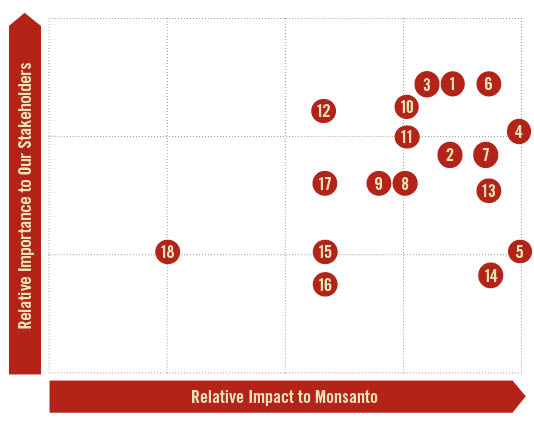
This materiality analysis matrix helped define the issues that we can positively impact around the globe.
Issue Descriptions
- Water: Protecting and preserving water resources in agriculture
- Nutrition: Access to safe, nutritious agriculture-based products
- Food Security: Protect and grow yield to meet growing global needs for food, fiber and energy
- Continuous Improvement in Agriculture: Systems-based solutions & enhanced information that creates value for farmers
- Employees: Attracting, developing and empowering our people while providing a safe, diverse and rewarding working environment
- UN 7 Product Safety & Stewardship: Products and technologies that meet or exceed regulatory requirements relative to safety, the environment and use
- Farmer Livelihoods: Improving the lives of our farmer customers and the economic vitality of farming communities
- Dialogue & Engagement: Actively engaging with stakeholders for awareness, perspective and input
- Technology Innovation & Access: Safeguarding intellectual property while enabling access to products and innovations
- Business Ethics & Transparency: Operating in a compliant, ethical and socially responsible way
- Environment: Stewarding the environment throughout our operations, managing our footprint. See also Biodiversity, Climate Change, Water
- Climate Change: Helping farmers mitigate and adapt to climate change
- Local Communities: Enhancing the communities in which our employees and customers live and work
- Youth in Ag & Science: Championing the next generation of agricultural innovators
- UN 1 Human Rights: Supporting the human rights of our employees and business partner employees
- Sustainable Supply Chain: Promoting sustainable behavior in our supply chain
- Biodiversity: Supporting increases in natural habitats and habitat protection
- Legacy Matters: Indemnification obligations related to certain historical business operations and chemical products