Environment
The Challenge of Water
More than any other natural resource, water connects all of us. It’s at the center of economic, social, environmental and political issues. Farmers depend greatly on water. The amount, availability, and cleanliness all weigh heavily on farmers all over the world.
In fact, farming uses 70 percent of the world’s available fresh water withdrawals. As we look at all of the challenges we face to support an ever-growing population, water may be the most important issue.
From an agricultural perspective, it’s the single most limiting factor for crop production, crop growth and development. We’ll need to roughly double the food supply to feed our growing planet, and we’ll have to do it with less water than we are using for agriculture now. Our team is committed to working with farmers to address the challenge of water and offer sustainable solutions to help them meet their demands while improving yields.
Our company position on water is divided into three broad areas:
- Our Operations
- Products & Partnerships
- Advocacy & Awareness
Within each of these areas, there are specific programs that will drive results.
Facts & Figures
Water Scarcity Mapping
Currently, we are using a process to evaluate all of our sites around the world regarding the use of both surface and ground water and any associated potential impact to water resources in the area. We’ve taken it upon ourselves to create a computer-based program that will help us more effectively monitor our water usage.
We evaluated a number of potential databases and identified those that were worldwide in scope, from a trusted source, easy to use, and produced the most beneficial outputs. We will be using these publically available databases to record global water use at our sites to provide valuable insight. This information is expected to be available in future iterations of our sustainability reporting.
Drought Impact on Yields
Just over 80 percent of U.S. agricultural land experienced drought in 2012, which made it the most extensively experienced drought since the 1950s. The lack of rain damaged large portions of crops in the U.S. Midwest, leaving field corn and soybeans the hardest hit. Retail food and animal feed prices increased, and forecasters have indicated the nation will feel the pinch well into 2013. More than 2,000 counties in the United States were designated as disaster areas, and about 60 percent of farms were located in areas experiencing drought. In short, this drought affected farmers and made an already challenging job even more challenging. As bad as it was, it could have been much worse, if not for improvements in irrigation, seed and other technologies.
Yields in 2012 v. 1988
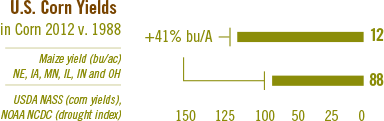
The U.S. drought of 2012 was very similar to the one in 1988. The lack of water pushed farmers to the limit. Yields were down and costs skyrocketed. But the difference between 1988 and 2012 was technology. Because of better breeding, use of biotechnology, and better agronomic practices, the American farmer saw yields that were actually 41 percent higher than they were in 1988—an average of 35 bushels per acre higher than in the same drought conditions of 1988. The data shows us, and the farmer, that the work we’re committed to is effective. With climate change statistics forecasting a scenario worse than originally projected, it’s a fact that water will grow scarce. Compound that scarcity with continuing possible drought-like conditions, and it becomes clear why our people are investing in drought readiness technologies.