Communities
Project Share
Many farmers in India use traditional planting methods, which can reduce the maximum yield possible from their seeds. Farmers are accustomed to planting corn seed mixed with fertilizer, using a bullock-drawn indigenous plow. This tends to kill the germinating seed and result in fewer plants actually growing in the field. However, the biggest issue with this method is the planting of too many seeds; excessive plant populations drain the soil of moisture and nutrients.
Monsanto India and the Indian Society of Agribusiness Professionals partnered with Project SHARE (Sustainable Harvest: Agriculture, Resources and Environment) to help farmers improve planting methods by developing the seed and fertilizer drill. This device controls seed and fertilizer quantities to conform to ideal spacing recommendations. The drill contains a double-box seed drill with sub-sections divided for seed and fertilizer, making it possible to adjust seed and fertilizer rates individually.
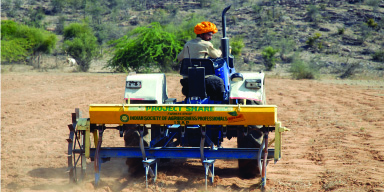
Jamuna Lal, Indian farmer, using a new sowing and fertilizing drill that revolutionized his farming practice.
The development and adoption of the seed drill has enabled farmers to plant at appropriate seeding rates and separate the seed and fertilizer for efficient planting. Farmers have seen yield increases anywhere from two to six tons per hectare in one growing season. They’ve also seen more accurate seed rates, meaning fewer seeds per hectare, which saves on inputs like fertilizer.
The machine, shared across villages, is instilling immense pride and a real sense of ownership. Those who are witnessing the results are now believers in innovation and the use of improved seeds and technology. Project SHARE’s goal is to improve the lives of Indian farmers by giving them access to tools like these, technology and knowledge, so they can increase cotton and corn crop yields, improve their income, and by extension, their quality of life.