Environment
Our Water-Focused Research and Development
GRI EN 26 We have invested considerably in water-related products and processes. Our commitment to farmers who are faced with this issue never wavers. Besides being founding members and partners to numerous philanthropic organizations, we’ve invested heavily in technologies that give farmers access to sustainable water.
Conservation Tillage
Conservation tillage is the agronomic practice of limited or no tillage of the soil. This method leaves residue from a previously harvested crop on top of the soil, which reduces soil erosion and run-off. This process, originally introduced 30 years ago, needed a champion to promote its practice and advocate its benefits. We joined with farmers and others in the agriculture industry to form the Conservation Technology Information Center (CTIC). Originally named the Conservation Tillage Information Center, the CTIC’s mission has expanded to include other conservation practices. This center helps farmers, governments and members of the environmental community understand the importance of these conservation practices.
Today, nearly 50 percent of all cropland benefits from some version of conservation tillage. There is still more work to be done as the agriculture industry strives to increase conservation tillage acres. Recently, CTIC paused to celebrate 30 years as an organization, which culminated with an event at Monsanto’s St. Louis, Missouri, campus in October, but the group has not slowed in its advocating for conservation tillage.
NEARLY 50% OF ALL CROPLAND BENEFITS FROM SOME VERSION OF CONSERVATION TILLAGE
GRI EN 26 Gothenburg
Our Gothenburg Water Utilization Learning Center in Gothenburg, Nebraska, is focused entirely on water and its role in growing food. This state-of-the-art facility serves two functions: as a learning center for farmers, students, media and the general public, and secondly, as a research facility with an emphasis on building a systems-based approach in helping farmers increase their yields while using fewer resource inputs, particularly water.
Gothenburg is a desirable location to conduct research because it is near the center of the state of Nebraska. In Nebraska, precipitation varies from 34 inches in the east to 14 inches annually in the west. Gothenburg receives an average of 23 inches of rain annually. This places our facility in the transition zone of dry land farming to irrigated farming. As a result, we have research on both systems to help farmers understand how to manage water better.
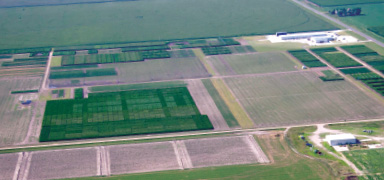
Gothenburg Water Utilization Learning Center in Gothenburg, Nebraska is focused entreily on water and its role in growing food.
Our team is also using our Gothenburg facility to determine the relationship between water use and yields when different management approaches are applied. In a demonstration called “The Journey of Drought”, we applied six different combinations of agronomic practices, hybrid selection and biotech trait protection to measure the impact of drought on the various parts of a corn-growing system. The combinations ranged from poor to best practices, and we found that when the best of agronomic practices, hybrid selection, and biotech traits were used, this combination produced more bushels for every inch of water.
To learn more about the facility and our research visit: http://www.monsanto.com/improvingagriculture/Pages/gothenburg-water-utilization.aspx#.UWgbB0LZep0
GRI EN 26 Genuity® DroughtGard™ Hybrids
There is no magic solution to solving the impact of drought on a plant. However, research into understanding drought and its complex mechanisms has come a long way in recent years. Hybrid selection and agronomic practices for drought-prone areas have shown solid results.
DUE FOR RELEASE IN 2013
BIOTECH TRAIT TO HELP MANAGE THE RISK OF DROUGHT STRESS

Research into how crops tolerate drought conditions isn’t new. DEKALB®, our national brand for corn seed, has been rating its hybrids for drought-tolerance since the 1970s. Using biotechnology as a tool to address drought hasn’t been available, until now. In collaboration with BASF, we’ve discovered a biotech trait that can give corn seed the enhanced ability to better utilize water. Combined with hybrid selection and the use of agronomic practices, Genuity DroughtGard hybrids have the potential to enhance yield stability for U.S. farmers during times of drought stress.
Due for release in 2013, these seeds have native drought-tolerant characteristics and a biotech trait to help them manage the risk of drought stress. These seeds will be grown under stewardship requirements while pending import approvals in key export markets.
Learn more at:
http://www.monsanto.com/improvingagriculture/Pages/genuity-droughtgard-hybrids.aspx