Communities
Monsanto’s Human Rights Progress
Across the globe, stories abound about the rights of workers being abused in various industries including agriculture. Because we produce seeds in more than 40 countries, our people are in a position to improve the lives of workers in our seed production supply chain. In 2006, we adopted our Human Rights Policy that set high standards for our sites and our business partners, who provide manual labor in the production of our seeds.
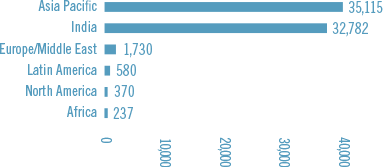
Monsanto Human Rights Business Partners by Geographic Area, 2012
Monsanto Data
GRI HR 10 Our priorities are guided by a global risk assessment, which covers each part of the Policy in every country where we grow our seeds. We encourage our business partners to follow our lead and champion those who need support. We work on a country-by-country basis to evaluate our business partners and look closely at how they treat our most valuable resource – people.
Our Practices and Policy
Our Human Rights Policy has identified nine areas of commitment. They are:
- Child Labor
- Forced Labor
- Compensation
- Working Hours
- Harassment & Violence
- Discrimination
- Freedom of Association
- Occupational Safety
- Legal Compliance
GRI HR 1 Our continuous improvement approach frames our process and helps us identify high-risk countries and focus our resources to make the greatest impact possible. All of our seed supply contracts are structured to include a human rights provision. By signing the contract, our business partners indicate that they have read and understood the Policy and agree to act in compliance with applicable labor laws. We’re proud to announce that in 2012, we had a major increase in the number of business partners in two critical geographic areas, Asia Pacific and India, and we maintained our high standards with our human rights clause in 100 percent of the contracts.
GRI HR 2 GRI HR 7 A second practice our people use with our business partners is to test their compliance with our Red Flag Assessment, a 22-question screening tool. In 2012, we conducted 37,494 assessments, the majority of which were in India. If a red flag was found, indicating a potential problem, we launched an immediate investigation.
In some of our highest risk areas, we provided in-person training to communicate our expectations. GRI HR 10 We’ve found a face-to-face approach is very effective in reaching more than 26,000 of our business partners in these areas. Unfortunately, if we uncover issues that cannot, or will not, be addressed by our business partners, we have to terminate their contracts. In 2012, we discontinued working with three business partners in Malawi because of issues that couldn’t be resolved. In India, we found 240 children on 171 farms this past season, and all of those 171 business partners were disqualified from our program for the future.
As we continue to improve our process, we’ve hired 3rd party risk assessment specialists to help us with our screening procedures. These consultants conducted in-depth analysis in parts of Africa, Latin America and India. When potential violations were uncovered, the concerns were immediately raised with our business partners and corrective actions were put in place.
For example, at our plant in Lusaka, Zambia, we identified a problem with accurately tracking working hours. A simple fix for our business partner was to install an electronic time clock system, which eliminated concerns about accurate payment based on hours worked.
In Malawi, we found that some business partners couldn’t pay their workers until the harvest was completed and they received payment for the seeds. To address the issue, we began paying our business partners a mid-season payment so their workers could be paid in a more timely way.