Commitments
Our Commitment to Sustainable Agriculture
Each day, the world supports another 200,000 people more than the day before. As the population increases, so does the demand for food, fiber, energy and water.
By 2030, global demand for soybeans will be 125 percent more than it was in 2000. Arable land per capita in 2030 will be just one third of what was available in 1980. And without essential improvements in productivity, there is a projected 40 percent gap in the amount of global water supply that will be available in 2030 versus expected demand. We must wisely use our natural resources to meet these future challenges.
Water Gap
Productivity Improvements Required to Close Future Water Gap
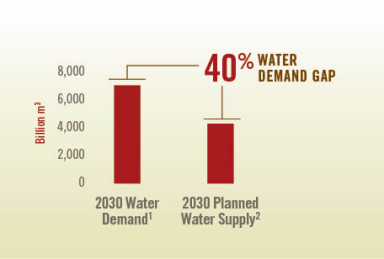
Source: Water 2030 Global Water Supply and Demand model; agricultural production based on IFPRI IMPACT-WATER base case
Arable Land Per Capita Losing Ground to World Population Growth & Economic Development

Source: IHS Global Insights, Agriculture Division
Global Demand for Crops Projected to Grow Dramatically

Source: IHS Global Insights, Agriculture Division
To do our part in addressing these challenges, in 2008, we set ambitious goals for continuous improvement in the agriculture sector following a year of analysis and dialogue sessions with more than 100 experts in the agriculture, food, international development, not-for-profit and government sectors. The goals were established to challenge our organization to align our unique breeding, biotechnology and agronomic management capabilities with the anticipated needs of our stakeholders.
YIELDS WILL NEED TO DOUBLE BY 2030
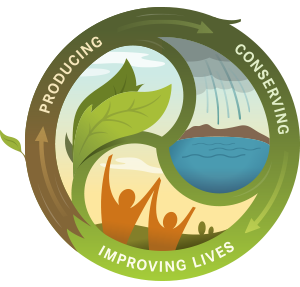
Monsanto’s sustainable agriculture goals are threefold:
Producing More
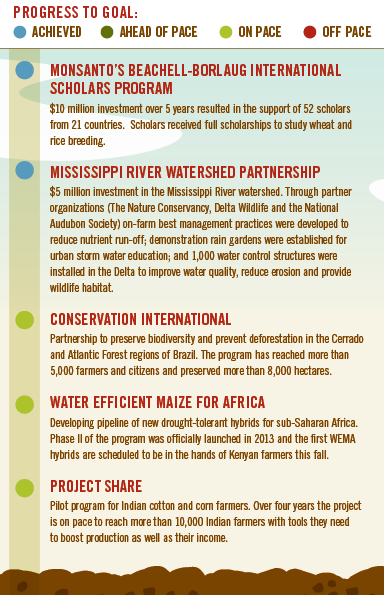
Developing improved seeds and agronomic practices to help farmers double yields by 2030 from 2000 levels for corn, soybeans, cotton and canola. In addition, we pledged $10 million to support rice and wheat breeding, crops essential to food security, by establishing Monsanto’s Beachell Borlaug International Scholars Program.
Conserving More
Conserving resources by developing seeds and agronomic practices that by 2030 use one third fewer key resources than in 2000 per unit of output to grow crops, while working to lessen habitat loss and improve water quality.
Improving Lives
Helping improve the lives of farmers and their families, including 5 million people in resource-poor farm families by 2020.
We acknowledge that Monsanto, acting alone, cannot accomplish these goals. However, as an agricultural company focused on increasing crop yields sustainably, we have pledged our best efforts to support the needs of farmers as they tackle these challenges. We are also committed to working with partners, new and already established, who offer diverse capabilities to address the daunting challenges.
GRI EN 18 Sustainable Agriculture Goals
Producing More
Our people are committed to providing a suite of solutions to farmers so that they can work to double yields in our core crops to meet increased demand. Through our many partner-based initiatives, we also continue to develop and provide solutions for smallholder farmers in places like Africa and India.
GOAL
DOUBLE THE YIELDS OF CORN, SOYBEANS, COTTON AND SPRING-PLANTED CANOLA BETWEEN 2000 AND 2030
PROGRESS INDICATOR
NATIONAL AVERAGE CROP YIELD LEVELS IN LEADING COUNTRIES
METHOD
COUNTRY-BY-COUNTRY COMPARISONS, YEAR-OVER-YEAR
Monsanto tracks progress against the goal of doubling yields based on the enabling policy conditions for investing in yield-enhancing technologies within the major corn, soybean, cotton and canola producing countries. In 2012, each country was objectively classified as having high, medium and low yield enabling policy conditions by The Context Network (Report: Global Crop Production Systems. The Content Network report uses different terminology for remaining countries.). The classifications are based on the ability of farmers to access the full complement of yield-enhancing technologies (breeding, biotechnology and agronomic management). We then track and report progress on the goal of doubling yields for the groups of countries with high technology adoption. The data is reported employing a three-year rolling average for the crop production years 2010, 2011 and 2012.
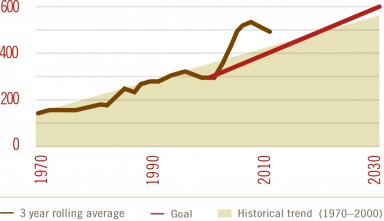
For the 2011 reporting year, cotton farmers have made the most progress toward the goal of doubling yields. They are on pace to do so with farmers in South Africa leading the way. Cotton farmers in India are ahead of pace and Brazilian farmers are on pace to the goal. U.S. farmers were on pace toward the goal; however, their yields lagged recently due to severe weather conditions.
The Context Network report uses different terminology for remaining countries.
Cotton Yield Response in India (KG/HA)
Source: USDA PS&D Database
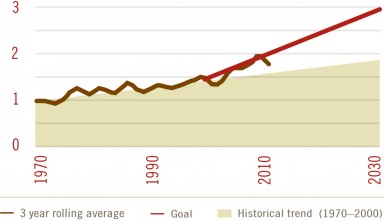
Canola Yield Response in Canada (MT/HA)
Source: USDA PS&D Database
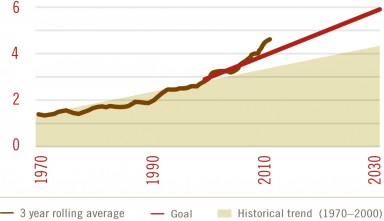
Corn Yield Response in Brazil (MT/HA)
Source: USDA PS&D Database
In canola producing regions, Canadian farmers have the best performance, but have only recently fallen off the pace due to weather and disease pressures. U.S. farmers have increased yields since 2000; however, they will need to see more rapid progress to get back on pace.
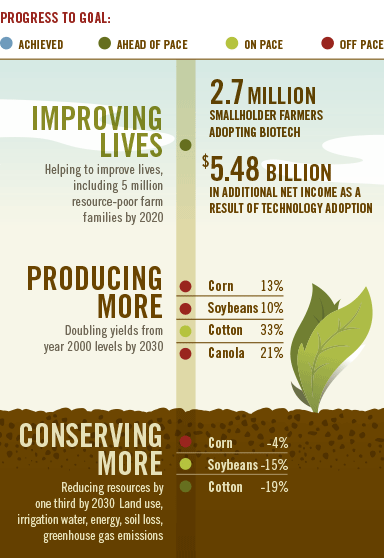
Among corn producing countries, Russia, Ukraine, Brazil, Paraguay and the Philippines have some of the best results and are well ahead of pace on the goal of doubling yields. Countries such as Uruguay and Canada are effectively on the pace required. Overall, among the countries with the highest level of access to technology, progress slipped back to just 13 percent above the yield levels achieved in 2000. This is in large part due to two poor weather years for corn production in the United States. The drought of 2012 was considered to be similar to the two worst drought years in the past 100 years (1988 and 1933). Prior to the most recent poor weather years, U.S. corn farmers were on pace to double yields. While corn farmers are off pace due to the drought, without improvements in irrigation and seed technologies, yields could have been much worse. Find more information on the 2012 drought in our Environment chapter. With normal weather patterns in the U.S. corn belt, significantly higher yields are expected.
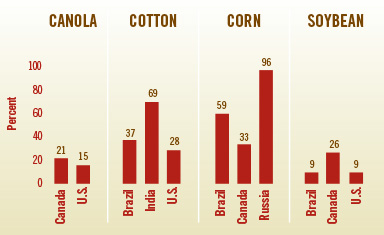
The most challenging crop relative to the goal of doubling yields is soybeans. Almost across the board, yields have been significantly off pace with what will be required to double yields by 2030. The industry has seen only a 10 percent gain since 2000 levels. Canadian farmers have exhibited the highest gains with yields at 26 percent more than 2000 levels. Roundup Ready 2 YieldTM soybeans have been widely adopted in Canada and recent weather patterns have been favorable. U.S. soybean yields have slipped back with the recent poor weather; however, the adoption of Genuity® Roundup Ready2Yield® soybeans with the advanced breeding improvements that provide the potential for higher yields in better weather conditions may help the needed course correction for the U.S. trajectory. In Brazil we anticipate high demand by farmers to plant Monsanto’s INTACTA RR2 PRO™ soybeans given the yield benefits that have been observed in field trials.
Pace To Goal – Doubling Yields (200-2030) – Selected Countries
Source: USDA PS&D Database
GRI EN 18 UN 8 Conserving More
Monsanto is proud to be a founding member of Field to Market: The Keystone Alliance for Sustainable Agriculture. Field to Market has risen to the challenge of comprehensively measuring the resource intensity of major row crops in the United States. Key performance indicators measured by Field to Market include land use, climate impact, energy use, irrigated water use and soil loss.
GOAL
REDUCE AGGREGATE USE OF KEY RESOURCES BY ONE-THIRD PER UNIT OF OUTPUT BETWEEN 2000 AND 2030
PROGRESS INDICATOR
EFFICIENT USE OF LAND, WATER AND ENERGY; MINIMIZATION OF SOIL LOSS AND GREENHOUSE GAS EMISSION
METHOD
REPORTING OF ECO-EFFICIENCY DATA IN THE U.S. AND OTHER LEADING COUNTRIES AS AVAILABLE
Employing a three-year rolling average of Field to Market data and analytical methods in 2011, cotton farmers in the U.S. are tracking ahead of pace to achieve the goal of one third fewer key resources per unit of crop output. U.S. cotton farmers have achieved a 19 percent increase in resource efficiency and are ahead of pace. Soybean farmers have achieved a 14 percent increase in resource use efficiency and are on pace with the goal. Corn farmers have seen a 4 percent increase in efficiency when it comes to conserving natural resources. While corn farmers are off pace, it is largely due to the historic 2012 drought in the United States. In fact, progress toward this goal for cotton, soybean and corn farmers was significantly impacted by the 2012 drought. Find more information on the 2012 drought in our Environment chapter.
Monsanto is supporting efforts to document similar data and analytical methods in additional countries. Multi-stakeholder efforts in Canada, Brazil and Spain have developed efforts largely aligned with the Field to Market effort in the United States. Moreover, Monsanto is consistently voicing our support for more robust efforts to collect data on a global basis that would allow for more consistent monitoring of resource-use intensity levels in agricultural production systems.
In addition to participating in a value chain effort like Field to Market, we have invested time and resources into creating new technologies that will allow farmers to use fewer resources while still increasing yield. We believe that when we provide better seeds and promote innovative agronomic practices, farmers can move toward achieving our “Conserve More” goal of using one third fewer key resources per unit of output to grow crops and dramatically lessen their global footprint.
Pace to Goal Using 1/3 Less Key Resources by 2030
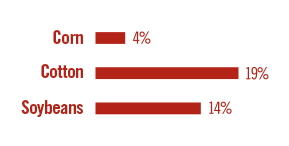
by percent
For example, studies have shown that irrigation to support crop production accounts for 70 percent of global fresh groundwater annually. And the total global demand for water is projected to increase by 40 percent through 2030 (Charting Our Water Future Exec Summary). There is no doubt that farmers need to find innovative ways to use less water. We are working hard to deliver solutions that aid in that endeavor. Our facility in Gothenburg, Nebraska, has been pioneering new ways to use less water through systems-based agriculture. We’re also been making progress in energy consumption and soil health through our research into Integrated Farming SystemsSM (IFS). This innovative approach works to deliver maximum yield potential to farmers through breeding technology combined with equipment technology advances.
GRI EC 9 Improving Lives
Monsanto believes that agriculture can only be sustainable if the livelihoods of farmers and their families are improving. We seek to improve the lives of all farmers we are privileged to serve; however, we also set a goal of achieving a measurable improvement in the lives of at least 5 million people living in resource-poor farm families between 2008-2020.
GOAL
HELPING TO IMPROVE LIVES, INCLUDING 5 MILLION RESOURCE-POOR FARM FAMILIES BY 2020
PROGRESS INDICATOR
NET INCOME GAINS AMONG FARMERS ADOPTING IMPROVED CROPS AND SYSTEMS
METHOD
GLOBAL META-ANALYSIS OF NET INCOME EFFECTS ATTRIBUTABLE TO IMPROVED CROPS AND SYSTEMS
While we all have a stake in the future of agriculture, farmers’ livelihoods are rooted in the success of their farms. As they become more efficient, prospects improve to increase their household income levels. When incomes are improved in farming, rural communities where farming is prominent achieve higher rates of job creation and economic expansion.
The Effect of Investing in Agriculture on Incomes
Agriculture is still one of the largest sources of employment and wealth creation across the globe. According to research done by the United Nations University, the agriculture sector is significantly more effective than non-agriculture sectors in reducing poverty among the poorest of the poor.
Reducing Poverty Among the Poorest of the Poor
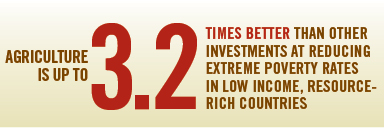
Based on global meta-analysis data compiled by ISAAA and PG Economics, 2.7 million resource-poor farmers have adopted biotech crops since 2008. These farmers achieved $5.48 billion in additional net income as a result of this technology adoption. Based on farm household population levels in the locations where these technology adoptions occurred, 9 to 15 million people in resource poor farm families are estimated to have shared in these benefits. Due to the economic multiplier effect of agriculture, the communities where these farmers lived are estimated to have received $3 to $7 in additional value in their communities for every $1 of additional income realized by the farmer.
Working with African governments and organizations, the Bill and Melinda Gates Foundation, the Howard G. Buffett Foundation, the U.S. Agency for International Development (USAID), and the International Maize and Wheat Improvement Center (CIMMYT), the Water Efficient Maize for Africa (WEMA) program aspires to help African farmers increase productivity and improve their livelihoods, so they can feed their families and afford education and health care for their children. (Link to WEMA story). The WEMA program is developing new drought-tolerant and insect-protected corn hybrids for smallholder farmers. Part of our contribution is to provide the technology royalty-free to African seed companies, so that these new hybrids make it into the hands of farmers in sub-Saharan Africa. WEMA is one example of the many public-private partnerships we participate in to address food security in the developing world.
GRI EN 12 GRI EN 13 GRI EN 14 GRI EN 11 Signature Partnerships Scorecard