Environment
Water Advocacy and Partnerships
As we work to tackle the drought issue, we know our people can’t do it alone. In our efforts to help farmers adapt and flourish, regardless of conditions, we’ve found many concurring people, organizations and initiatives that have blossomed into partnerships. In some cases, we were founding members. In others, we joined a group of already established philanthropists addressing important issues.
WATER SECURITY IS ONE OF THE WORLD’S BIGGEST CHALLENGES

Water for Food
Water security is one of the world’s biggest challenges. At the center of that challenge is the water supply needed to grow the food required for an increasing population. We can’t make more water; the only way forward is through innovations in water productivity.
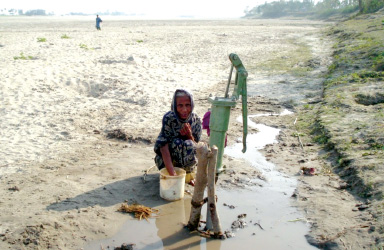
Photo: Firoj Alam
A woman fetches water in Gaibandha, a rural district in Bangladesh.
Established in April 2010 with a $50 million founding gift commitment from the Robert B. Daugherty Charitable Foundation to the University of Nebraska, the Water for Food Institute conducts research and provides policy analysis and educational programs on the efficiency and sustainability of water use in agriculture. Specifically, the institute focuses on ensuring the food supply for current and future generations.
Monsanto partners with the University of Nebraska–Lincoln to help farmers manage water stress. We fund Plant Science and Cropping Systems graduate students and also co-fund the salary of a University Extension Specialist. The Extension Specialist spends half of his time at the Gothenburg Learning Center, interacting with and teaching visitors, helping us plan water-related field demonstrations, linking us to University of Nebraska expertise, and testing the network of water and cropping systems. The individual who fills this role for the University of Nebraska is an irrigation expert and spent three previous years working with the third largest center pivot irrigation manufacturers in Nebraska, building and implementing an irrigation efficiency educational program.
We’re proud of our partnership with the Water for Food Institute. We have been a lead sponsor of their conference since 2010 and spoke at their 2012 conference. To learn more about their valuable cause and work visit: http://waterforfoodinstitute.org
“The Robert B. Daugherty Water for Food Institute is grateful for Monsanto’s partnership and support, which has enabled discussions of critical issues at our global conferences and a deeper hands-on understanding of the importance of production agriculture in meeting this challenge.”
–Prem S. Paul, Vice Chancellor for Research and Economic Development at the University of Nebraska-Lincoln
GRI EN MA GRI EN 9 GRI EN 11 GRI EN 12 GRI EN 13 GRI EN 14
Mississippi River Watershed Partnership
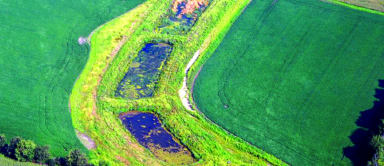
In addition to our efforts to help farmers increase yields with less water, we also understand how important it is to support the communities where they live and work. That means taking an interest in the environment that surrounds farms and the environment that surrounds our facilities and sites.
53,000 POUND REDUCTION OF NITRATES ENTERING THE ROOT RIVER WATERSHED ANNUALLY
The Mississippi River Watershed Partnership is a part of our commitment to the environment. This initiative was established to reduce nutrient run-off and sediment movement into the largest river system in the U.S. Monsanto contributed financial support to the agricultural and conservation groups Delta Wildlife, The National Audubon Society and The Nature Conservancy and worked with farmers and urban areas to help reduce run-off into the Mississippi River and the Gulf of Mexico.
NINE AUDUBON RAIN GARDEN DEMO SITES ALONG THE MISSISSIPPI HOST MORE THAN 1 MILLION VISITORS ANNUALLY
Both the Nature Conservancy and Delta Wildlife worked with us to prevent nutrient and sediment run-off, while the National Audubon Society focused on raising awareness of how people can be good stewards of nature in their own backyards. They promoted individual actions to enhance water quality and a healthy habitat for birds and other wildlife.
This effort by Monsanto illustrated how we can make farming and conservation in the Mississippi River Watershed more compatible so that nature and people benefit from improved water quality and enhanced wildlife habitat.
We believe this initiative serves as an important stepping-stone toward the goal of preserving natural resources and wildlife in the Mississippi River Watershed for future generations.
DELTA WILDLIFE AND MISSISSIPPI FARMERS INSTALLED 1,000 WATER CONTROL STRUCTURES PREVENTING:
20,000 POUNDS OF NITROGEN
10,000 POUNDS OF PHOSPHOROUS
9,000 TONS OF SEDIMENT
FROM ENTERING THE GULF OF MEXICO